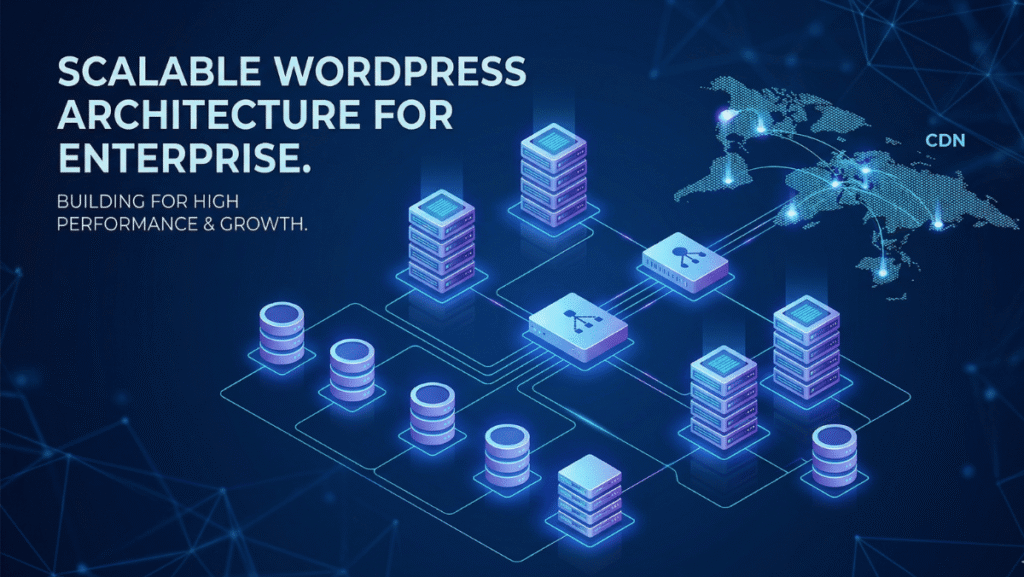
In the world of high-traffic digital platforms, a standard WordPress installation often falls short. For businesses looking to expand globally, the focus must shift from simple web design to building a scalable WordPress architecture. This technical foundation ensures your site remains fast, secure, and functional even under the pressure of millions of concurrent users.
What Defines Enterprise-Level WordPress Architecture?
Scaling WordPress isn’t just about adding more RAM to your server. It requires a holistic approach to the “Tech Stack.” A truly scalable WordPress architecture utilizes decoupled components to ensure that a failure in one area doesn’t bring down the entire system.
- Horizontal Scaling: Using multiple web servers behind a load balancer rather than one giant server.
- Database Optimization: Implementing HyperDB or similar solutions to separate read/write queries.
- Object Caching: Utilizing Redis or Memcached to reduce the load on your MySQL database.
- Microservices Integration: Offloading heavy tasks like image processing or search to external APIs.
The Role of Headless CMS in Modern Scaling
One of the biggest trends for 2026 is moving toward a Headless WordPress approach. By using WordPress as a backend API and React or Next.js as the frontend, you create an incredibly scalable architecture. This separation allows the frontend to be served via a Global CDN, reducing latency to near zero regardless of where your user is located.
Advanced Security Protocols for Scalable Systems
As your site grows, so does the target on its back. An enterprise-grade setup must include WAF (Web Application Firewall) integration at the DNS level. Implementing Cloudflare Enterprise or Sucuri ensures that malicious traffic is filtered before it ever reaches your origin server, preserving resources for legitimate customers.
Performance Tuning: Beyond the Cache Plugin
To achieve elite performance scores, you must look deeper than simple caching. High-level WordPress insights suggest optimizing the Critical Rendering Path and utilizing modern image formats like WebP or AVIF via automated edge workers. This technical precision is what separates a standard blog from a global enterprise platform.
Conclusion: Building for the Future
Investing in scalable WordPress architecture is an investment in your business’s future. By planning for growth today, you avoid the technical debt and downtime that plague unprepared platforms. If you are ready to take your digital presence to the enterprise level, focusing on these architectural pillars is the first step.
Looking for technical leadership? Explore more WordPress insights or get in touch to discuss your next high-scale project.